In the world of international coffee trading, price is often determined by one crucial factor: Grading. For importers sourcing from Vietnam, understanding the difference between Grade 1 (G1) and Grade 2 (G2) is essential to balancing quality expectations with production costs.
Misunderstanding these specifications can lead to production issues or overpaying for raw materials. As your trusted partner on the ground, An Supply breaks down the technical differences to help you choose the right bean for your business.
1. The Core Difference: “Black & Broken” Percentage
Contents
In Vietnam’s export standards (following TCVN 4193:2005), the grading is primarily defined by the percentage of Black and Broken beans allowed in a shipment.
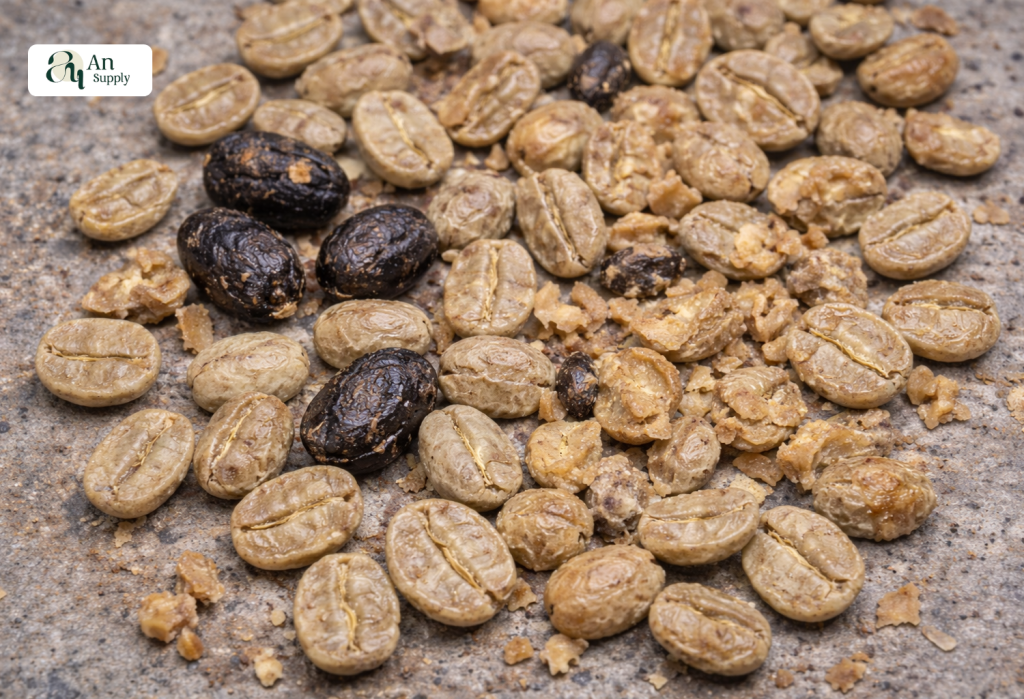
- Black Beans: Beans that are internally or externally black due to disease or improper drying.
- Broken Beans: Beans that are not whole (usually less than half the size of a full bean).

Grade 1 (G1) – The Premium Standard
This is the top-tier commercial grade, often referred to as “Standard Export Quality”.
- Black & Broken: Max 2% (usually written as 2% B&B).
- Foreign Matter: Max 0.5%.
- Moisture: Max 12.5%.
- Visual: The beans are uniform in color and size.
- Best For:
- Industrial roasters producing commercial ground coffee brands.
- Espresso blends where visual consistency and clean flavor are important.
- Markets with strict import regulations (e.g., Japan, EU).
Grade 2 (G2) – The Economy Choice
This grade allows for a higher tolerance of imperfections but offers a more competitive price point.
- Black & Broken: Max 5% (5% B&B).
- Foreign Matter: Max 1%.
- Moisture: Max 13%.
- Visual: Less uniform than G1; you will see more broken pieces and slight color variations.
- Best For:
- Instant Coffee Manufacturing: Since the beans will be extracted into soluble solids, visual appearance matters less than chemical yield.
- Low-cost Coffee Mixes: 3-in-1 brands where coffee is blended with sugar and creamer.
2. Screen Size: A Separate Metric
It is important to note that Grading (G1/G2) and Screen Size (S13, S16, S18) are often negotiated separately.
- You can buy Grade 1 Screen 18 (Large, clean beans – Premium price).
- You can also buy Grade 2 Screen 13 (Smaller beans with more defects – Budget price).
An Supply’s Advice: Don’t just ask for “Best Quality.” Ask for the specification that fits your final product. Buying G1 for instant coffee might be a waste of budget, while buying G2 for whole-bean retail bags is a risk to your brand reputation.
3. Why Accuracy Matters? The “An Supply” Guarantee
A common issue in the coffee trade is “Quality Fade”—where a supplier promises Grade 1 but delivers something closer to Grade 2 (e.g., mixing in 3-4% broken beans to cut costs).
At An Supply, Integrity is our currency.
- Transparent Specs: When we quote Grade 1 (2% B&B), we mean strictly max 2%. We do not play games with percentages.
- Pre-Shipment Inspection: We encourage independent inspections (like CafeControl) and our own QC checks to verify Moisture and Foreign Matter before the container is sealed.
- Consultative Approach: Not sure what you need? Tell us your end product (e.g., “I’m making a budget energy coffee”), and we will recommend the most cost-effective grade that doesn’t compromise your production line.
Conclusion
Whether you need the cleanliness of Grade 1 or the cost-efficiency of Grade 2, the most important specification is Trust.
An Supply ensures that what you sign on the contract is exactly what arrives at your port.
Need a quote for Robusta G1 or G2? Contact our export team today.