In the coffee trade, a handshake builds trust, but a Lab Report (Certificate of Quality) confirms reality. Whether it comes from CafeControl, SGS, or Intertek, this document is the “blood test” of your shipment.
However, many buyers only glance at the bottom line: “Passed.” This is a mistake.
Hidden within the numbers are critical indicators of the coffee’s shelf life, processing consistency, and true value.
As a supplier who prioritizes Technical Transparency, An Supply wants you to understand exactly what you are buying. Here is how to read a Lab Report to protect your interests, and how we optimize these metrics before shipping.
1. Moisture Content: The “Economic” Indicator
Contents
Typical Standard: Max 12.5% (Robusta) / 12.0% (Arabica)
Most buyers see this as a safety limit. We see it as an economic indicator.
- The Risk: If a report shows 12.9%, the coffee is technically compliant in some loose contracts, but dangerous. High moisture accelerates mold growth and bleaching (color fading) during transit. Furthermore, you are literally paying for water.
- The An Supply Standard: We aim for 11.5% – 12.5%. This is the “Sweet Spot.” It ensures the bean is dry enough to travel safely across oceans but retains enough moisture to preserve the embryo and flavor oils. We verify this with Halogen meters before the official lab takes samples.
2. Screen Size Analysis: The “Consistency” Indicator
Typical Standard: Min 90% on Screen X (e.g., Screen 16 for Grade 1)
This section tells you the uniformity of the beans.
- How to Read It: Look at the “Retention” (what stays on the sieve) vs. “Throughs” (what falls through).
- The Red Flag: If you buy Grade 1 Screen 18, but the report shows only 85% on Screen 18 and 15% on Screen 16, you are overpaying. You are buying a mix, not a premium grade. Small beans roast faster than large beans, leading to uneven roasts.
- The An Supply Standard: We calibrate our grading machines to ensure a minimum 90-95% retention rate on the specified screen. We want you to receive uniform beans for a uniform roast.
3. Defect Count: Black & Broken (The “Purity” Indicator)
Typical Standard: Max 2% (Grade 1) or Max 5% (Grade 2)
This is the most scrutinized number. But details matter.
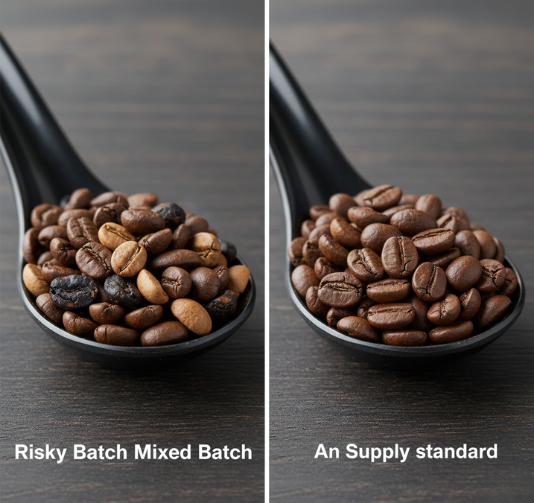
- Black Beans: Indicate fungal disease or extreme fermentation. They taste like charcoal or medicine.
- Broken Beans: Indicate poor hulling machinery. They burn easily during roasting.
- Foreign Matter: Stones, twigs, corn.
- The An Supply Standard: We treat “Foreign Matter” as a zero-tolerance metric. While the standard allows 0.5% or 1%, we use destoners and magnets to get it as close to 0.1% as possible. We know that one stone can destroy your $50,000 roasting grinder.
4. Bean Count (The “Density” Indicator)
Metric: Number of beans per 100g.
This is an underrated metric for quality.
- How to Read It: Fewer beans per 100g = Heavier, denser beans.
- Why It Matters: High-density beans (grown at better altitudes or well-nourished) generally possess more complex sugars and acids. They can withstand darker roasting profiles without turning ashy.
- An Supply Insight: We source form high-density regions (like Dak Mil, Dak Nong) to ensure our beans have the structural integrity required for intense industrial roasting.
5. Organoleptic Test (The Cup Profile)
A physical report is useless if the coffee tastes like dirt.
- Keywords to Watch:
- Positive: Clean, Neutral, Good Body, Woody, Chocolatey.
- Negative (Danger Signals): Fermented (Stinker), Moldy (Musty), Earth/Soil, Phenolic (Rioy).
- The An Supply Standard: Physical specs are just half the battle. Our internal cuppers taste every batch. Even if the beans look perfect (Grade 1), if we detect a “Fermented” note, we reject the lot immediately. We never rely solely on the machine’s eye; we use the human palate.

Conclusion: Don’t Just File It, Analyze It
A Lab Report is your insurance policy. But it only works if you know what the numbers mean.
At An Supply, we don’t just hand you a piece of paper. We walk you through the results, explaining every variance, so you know exactly the value you are receiving.
Want to see a sample Lab Report of our recent shipment? Contact us today.