In the agricultural trade, the “Sample” is the handshake. It is the physical promise of what is to come.
But for many international buyers, the sample is also a trap. Unethical suppliers often send a “Golden Sample”—a bag of hand-picked, flawless beans that looks nothing like the actual cargo sitting in the warehouse. When the container arrives, the buyer is shocked to find smaller sizes, higher defects, and lower quality.
At An Supply, we despise this practice. We believe that a sample that lies is a contract broken.
Here is our rigorous sampling protocol designed to ensure that what you see in the courier bag is exactly what you get in the container.
1. No “Cherry-Picking”: The Representative Reality
Contents
We do not hand-pick beautiful beans to impress you. That is marketing, not manufacturing.
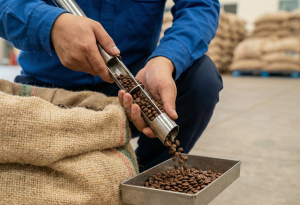
- The Method: When you request a sample, our QC team goes to the specific lot allocated for you. They use a Spear Sampler (Probe) to extract beans from the top, middle, and bottom of multiple random bags.
- The Result: The sample you receive will contain the average quality of the lot. If the lot has 3% broken kernels, your sample will have ~3% broken kernels. We want you to see the reality, so you can make an informed decision.
2. The Triplicate Protocol (The “Safety Lock”)
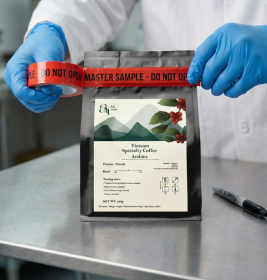
We never send a sample without keeping a backup. This protects both sides in case of a dispute. Every time we draw a sample, we create three identical sets (Triplicates):
- Offer Sample: Sent to you via DHL/FedEx for approval.
- Master Sample (Sealed): Kept at An Supply’s office, vacuum-sealed, dated, and signed. This is the “Control.”
- Production Reference: Sent to the factory floor manager. Their instruction is simple: “Produce the bulk exactly like this bag.”
Why this matters: If you receive the shipment and claim the quality is different, we open the Master Sample together (via video or in person) to compare. It eliminates the “he said, she said” argument.
3. Lot Mapping: Linking Sample to Inventory
A common trick is sending a sample from “Lot A” (Premium New Crop) but shipping “Lot B” (Old Crop).
- An Supply Protocol: Every sample bag we send has a Unique Batch Code printed on the label. This code corresponds to a specific physical stack in our warehouse.
- The Guarantee: When you approve “Sample #8821”, our system locks “Stack #8821” for your order. We cannot accidentally ship a different stack because the inventory system forbids it.
4. The “PSS” (Pre-Shipment Sample): The Final Check
The Offer Sample was approved months ago. But what does the cargo look like today, right before loading?
- The Process: One week before the vessel arrives, we draw a Pre-Shipment Sample (PSS) from the actual packed cartons ready for loading.
- The Power is Yours: We send photos/videos (or the physical PSS if time permits) to you. You give the final “Green Light.” If the PSS doesn’t match the original Offer Sample, we do not load the container. We re-process or replace the lot at our expense.
5. Third-Party Verification
Don’t just take our word for it.
- The Inspector’s Role: When SGS or Vinacontrol arrives, we give them the PSS or Offer Sample. They use it as the “Benchmark.” They check the bulk cargo against your approved sample, not just general standards.
Conclusion
A perfect sample that leads to a bad shipment is a business failure.
An honest sample that leads to a consistent shipment is a partnership success.
At An Supply, we don’t send “Golden Samples.” We send Honest Samples.
Request a representative sample today and see the An Supply difference.