In the global cashew trade, particularly for the US and EU markets, the AFI (Association of Food Industries) Specifications are the law. They define what you pay for.
But here is the harsh reality: AFI Standards are the “Minimum Requirement”, not the “Gold Standard”.
Many suppliers aim to barely pass the AFI specs. If the limit for defects is 8%, they ship 7.9%. This is dangerous. A rough sea voyage or a strict port inspection can easily tip that 7.9% over the limit, resulting in a rejected container.
At An Supply, we treat AFI specifications as the baseline, not the target. Here is a definitive guide to the standards that matter most—and how we engineer a “Safety Buffer” to protect your investment.
1. The Color Grades: Where Value Evaporates
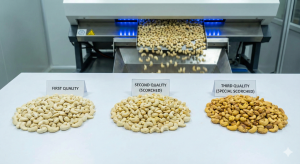
The biggest disputes in cashew trading happen over color. The difference between “First Quality” and “Second Quality” is purely visual, but the price gap is massive.
- First Quality (Fancy): The kernels must be uniformly light colors (white, light ivory, or light ash-gray).
- The Risk: “Scorched Tip”. Sometimes roasting or drying is uneven, causing brown spots.
- The An Supply Standard: We use color-sorting machines plus manual sorting to remove borderline kernels. If it looks even slightly yellow, it gets downgraded to Second Quality (Scorched). We don’t mix “almost white” into your White W320.
- Second Quality (Scorched): Kernels that are yellow, light brown, or have light ivory variation.
- Third Quality (Special Scorched): Kernels that are deep yellow or brown (often used for processing/dicing).
2. Sizing: The “Count Per Pound” Rule
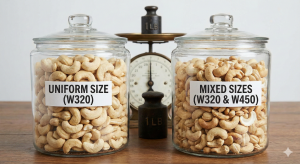
When you buy W320, it means there are between 300-320 kernels per pound.
- The Trap: Some suppliers mix smaller sizes (like W450) into W320 to increase weight cheaply. This leads to uneven roasting (small nuts burn while big nuts are raw) for your factory.
- An Supply Protocol: We strictly calibrate screens. Our W320 is consistently W320. Uniform size = Uniform roasting = Better flavor for your customer.

3. Defects: The “Serious Damage” Limit
AFI is very specific about what constitutes a defect.
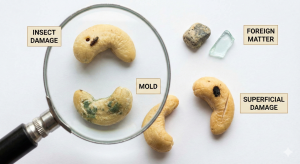
- Insect Damage: Zero tolerance for live infestation.
- Mold/Rancidity: Strictly forbidden.
- Foreign Matter: Stones, glass, metal.
- Superficial Damage: Scrapes, knife cuts, or black spots ( adhering testa).
The Critical Threshold: For First Quality, AFI allows a maximum of 8% Total Defects (including max 1% serious damage like mold/insect).
- Our Strategy: Shipping a container with 8% defects is suicidal. We target a maximum of 3-5% internal defects before packing. Why? because vibration during transit can cause breakage, increasing the defect rate upon arrival. By shipping cleaner than required, we ensure you receive goods that are still compliant after a 30-day voyage.
4. Moisture: The Invisible Enemy
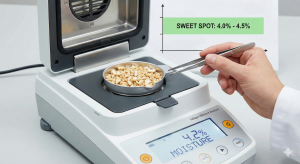
AFI dictates that cashew kernels should have a moisture content of 3% to 5%.
- Below 3%: The nut is too brittle and will shatter into dust during transport.
- Above 5%: The nut turns soft (“chewy”) and becomes a breeding ground for mold and fatty acid degradation.
- An Supply QC: We don’t guess. We use Halogen Moisture Analyzers on every batch. We aim for the “Sweet Spot” of 4.0% – 4.5% to balance crunchiness with structural integrity.
5. The “An Supply” Difference: Grading for the Destination, Not the Origin
Most factories grade their cashews to pass inspection at the factory gate.
An Supply grades your cashews to pass inspection at your warehouse.
We anticipate the stress of logistics. We anticipate the strictness of FDA/European port authorities.
- Traceability: Every carton is marked with a production code.
- Fumigation: Mandatory commercial sterilization before shipping to ensure zero pest survival.
Conclusion
Understanding AFI Standards protects you from buying garbage.
Partnering with An Supply protects you from the stress of enforcing those standards. We do the policing so you don’t have to.
Need a supplier who respects the spec? Contact An Supply for a quote today.