Shipping agricultural products from Vietnam to the US, Europe, or the Middle East is a battle against the elements. Your cargo will spend 30 to 45 days inside a steel container, exposed to extreme temperature fluctuations and salty ocean humidity.
For high-fat commodities like Cashew Kernels, standard packaging (PP bags or Jute bags) is a death sentence. It invites moisture, oxygen, and pests to destroy your product before it even reaches the shelf.
At An Supply, we view packaging not as a “wrapper,” but as a Life Support System. Here is why Vacuum Packaging is the only insurance policy that guarantees your cargo arrives as fresh as the day it was packed.
1. Stopping the “Rancidity Clock” (Oxidation Control)
Contents
Cashews are rich in natural oils. When these oils meet Oxygen, a chemical reaction starts immediately: Oxidation. This leads to that unmistakable, stale “old paint” smell known as rancidity.
- The Vacuum Solution: By sucking the air out, we remove the Oxygen fuel.
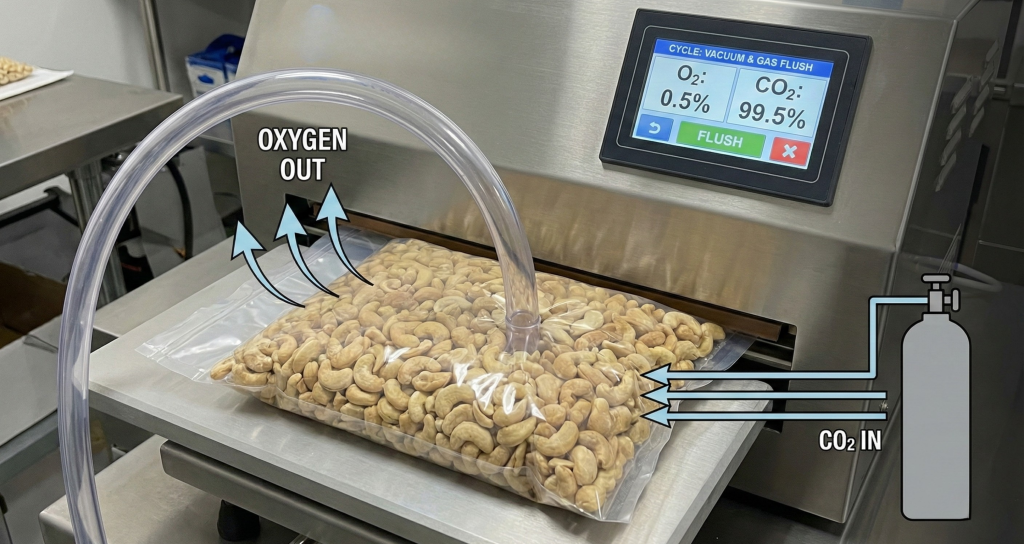
- An Supply Edge: For extra sensitive grades (like Organic or Premium White), we offer CO2 Flushing. We replace the oxygen with Carbon Dioxide (an inert gas) before sealing. This puts the nut in “suspended animation,” effectively freezing its aging process.
2. The Barrier Against Ocean Moisture
The humidity inside a shipping container can reach 90%. If you use standard bags, your dry, crunchy cashews act like a sponge, sucking up that moisture.
- The Risk: The nuts become soft (“soggy”) and chewy. Worse, moisture above 5% triggers mold growth and Aflatoxin.
- The Vacuum Solution: Our high-grade PA/PE (Polyamide/Polyethylene) bags create an impermeable barrier. No matter how humid the ocean air gets, the environment inside the bag remains bone-dry.
3. Pest Asphyxiation (The Ultimate Insect Control)
Fumigation kills live insects, but sometimes microscopic eggs survive deep inside the kernel. In a normal bag, these eggs can hatch during the warm voyage, leading to a container full of weevils upon arrival.
- The Vacuum Solution: No Oxygen = No Life. Even if an egg survives fumigation, it cannot hatch or grow in a vacuum environment. It is the safest, chemical-free way to ensure pest-free delivery.
4. Preventing “Dust” (The Friction Issue)
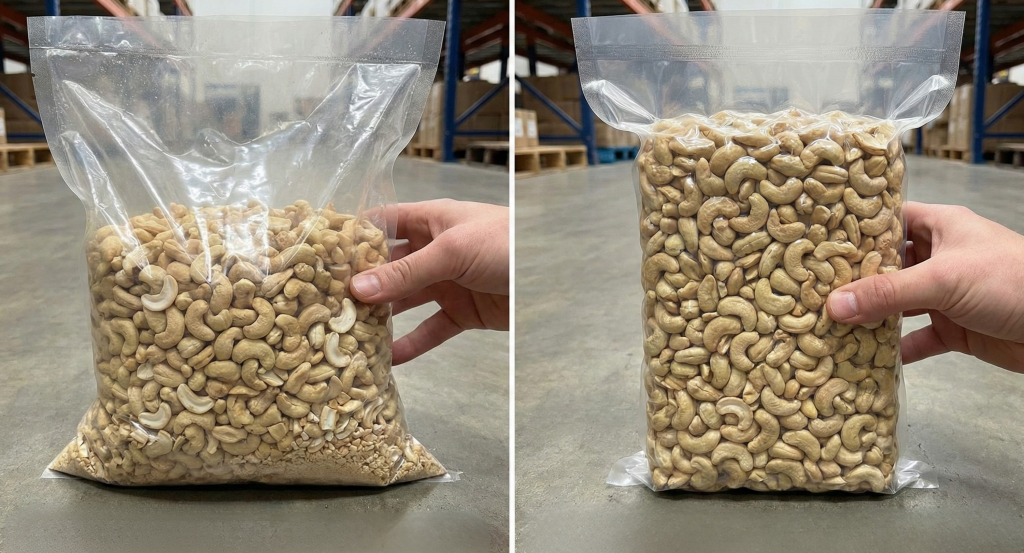
This is a technical detail few buyers think about. In a loose bag, nuts move and rub against each other as the ship vibrates. This friction creates Cashew Meal (Dust) and breakage at the bottom of the bag.
- The Vacuum Solution: When vacuum-packed, the bag becomes a solid, hard “Brick”. The kernels are locked in place and cannot move. This drastically reduces physical breakage during handling and transit.
5. An Supply’s Material Standard: Not All Plastic is Created Equal
Cheap suppliers use thin, single-layer plastic that punctures easily. A punctured vacuum bag is useless—it’s just a loose bag.
An Supply’s Protocol:
- Thickness: We use Heavy-Duty 100+ Micron bags.
- Material: Multi-layer PA/PE (Nylon-reinforced) for puncture resistance.
- The “Leak Test”: We hold packed cartons in our warehouse for 24-48 hours before loading. If any bag loses its vacuum seal (becomes “loose”), we repack it immediately. We do not load “leakers.”
Conclusion
Saving $100 on packaging to risk a $50,000 container is bad math.
Vacuum packaging is the industry standard for a reason. At An Supply, we execute it with military precision to protect your profit.
Ship safe. Ship vacuum. Ship with An Supply.