Cashew packaging solutions are not a “final touch.” In private label, packaging is the product—at least in the customer’s eyes.
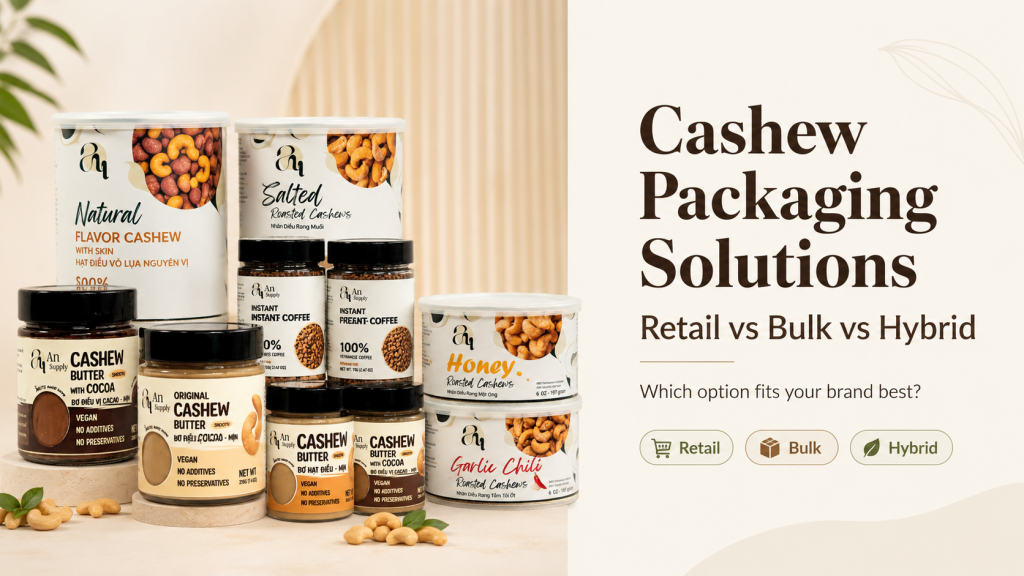
A great cashew can still lose on the shelf if the pack feels cheap, the seal fails, or the product arrives less crunchy than expected after a long route. On the other hand, premium packaging can quietly lift perceived value and repeat purchases—even when the ingredients remain the same.
So the real question isn’t “Which packaging looks nicer?”
It’s: Should your brand choose retail packaging, bulk packaging, or a hybrid approach—and why?
In this guide, we break down the practical trade-offs retailers and importers face when selecting cashew packaging solutions for global markets.
1. Retail Packaging: When Brand Experience Matters Most
Contents
- 1. Retail Packaging: When Brand Experience Matters Most
- Common retail formats for cashews
- Why retail packaging works
- Watch-outs
- 2. Bulk Packaging: When Distribution Efficiency Drives Decisions
- Common bulk formats
- Why bulk wins
- Watch-outs
- 3. The Export Reality: Packaging Protects More Than Appearance
- What to look for in export-ready cashew packaging solutions
- 4. How to Choose: A Practical Decision Framework
- 5. Why Partners Choose An Supply for Cashew Packaging Solutions
- 6. FAQ
- Is retail packaging always better than bulk?
- Which packaging is best for long-distance export?
- Can I launch with bulk first and switch to retail later?
Retail packaging is built for one job: to win in the consumer’s hand.
Common retail formats for cashews
- Stand-up pouches (zip lock): lightweight, modern, and cost-efficient
- Jars: premium positioning, gifting-friendly, strong shelf presence
- Small snack packs: great for trial and convenience channels, but higher complexity
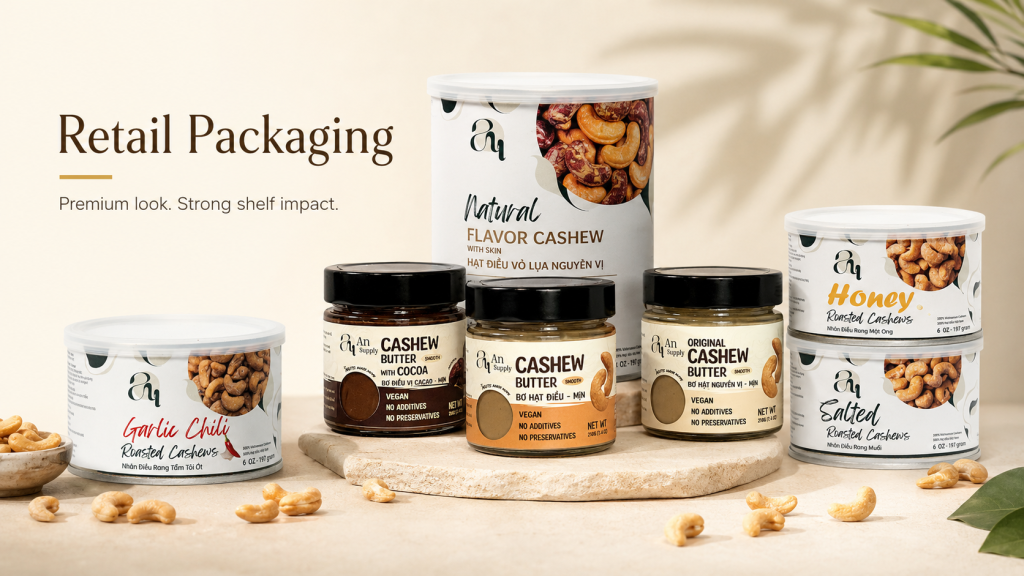
Why retail packaging works
- Stronger brand identity and shelf impact
- Easier to justify premium pricing
- Better consumer experience (resealable zipper, clean design, portion control)
Watch-outs
Retail packaging increases coordination:
- artwork + printing lead times
- label compliance per market
- higher packaging unit cost
- more touchpoints to control (sealing, oxygen barrier, moisture protection)
Retail packaging is ideal when your brand is built on presentation, convenience, and consumer trust.
2. Bulk Packaging: When Distribution Efficiency Drives Decisions
Bulk packaging is built to move volume with fewer variables.
Common bulk formats
- Bulk cartons for repacking locally
- Foodservice / B2B distribution formats
- Bulk for partners who already control local packaging and retail compliance
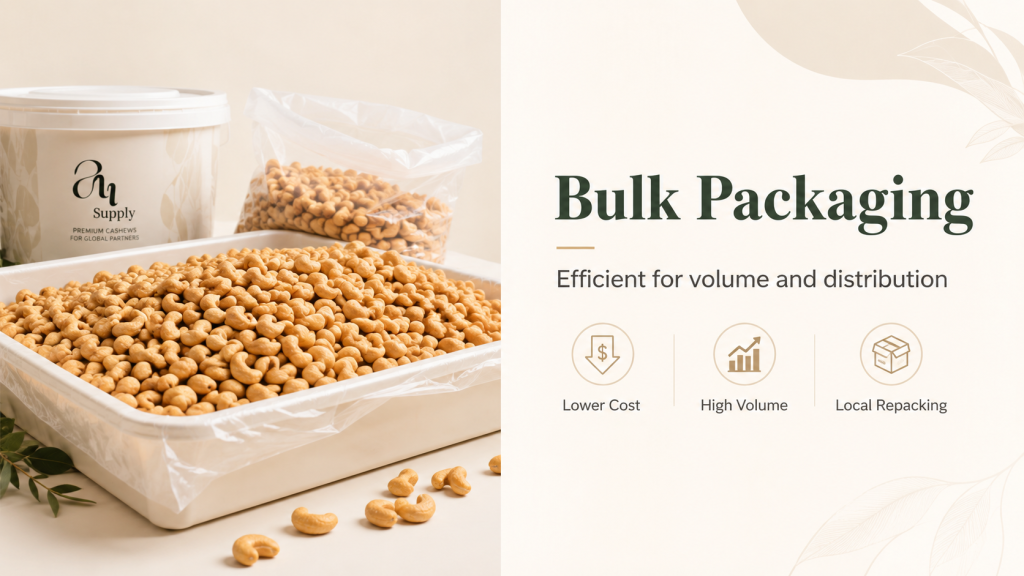
Why bulk wins
- Lower packaging cost per unit
- Faster scaling for high-volume contracts
- Simplifies labeling if repacking is done locally
- Efficient for importers with strong local packing operations
Watch-outs
Bulk is not automatically “safer”:
- it still requires moisture and oxygen protection
- mishandling at repacking can create quality issues
- your brand presence is weaker if the final consumer pack is not controlled
Bulk packaging fits brands prioritizing volume, cost control, and operational speed.
3. The Export Reality: Packaging Protects More Than Appearance
For cashew exports, packaging isn’t cosmetic. It’s protection against:
- humidity that steals crunch
- oxygen that accelerates rancidity
- heat exposure on long routes
- handling impact through ports and warehouses
What to look for in export-ready cashew packaging solutions
- strong moisture + oxygen barrier materials
- reliable sealing integrity
- clear labeling zones (traceability, origin, batch codes)
- packaging durability for stacking and transit vibration
When packaging fails, the cost is rarely just a refund—it’s brand reputation and future orders.
4. How to Choose: A Practical Decision Framework
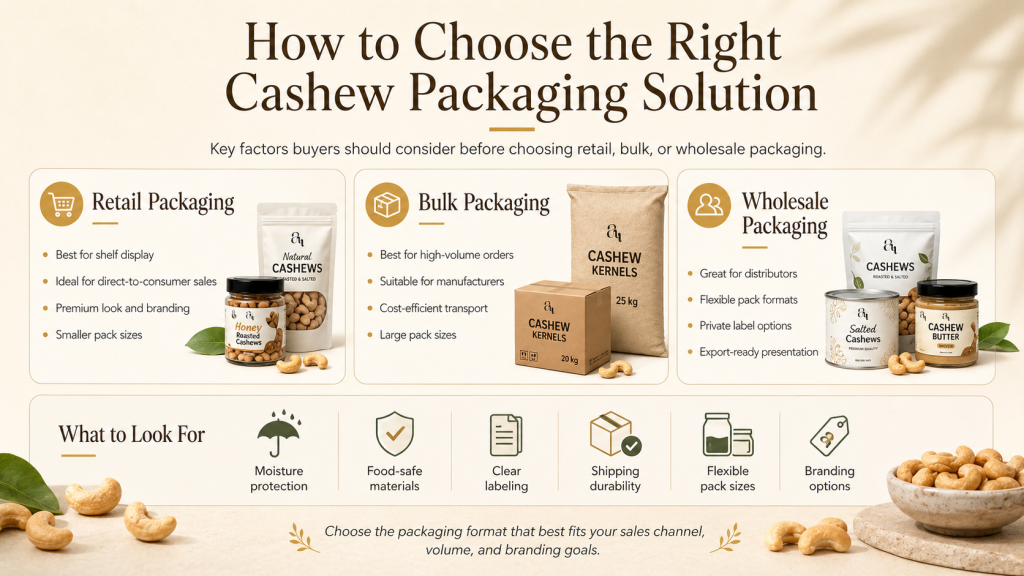
Choose retail packaging if…
- you want stronger shelf presence and brand control
- your channel is retail/e-commerce/premium gifting
- you’re building a private label brand story
- you want to reduce repacking risks
Choose bulk packaging if…
- you have a local packing facility or trusted repacking partner
- you’re optimizing cost per kilogram and contract volume
- you serve foodservice or large distributors
- your market requires localized labeling or packaging formats
Consider a hybrid approach if…
- you need both high-volume supply and branded retail SKUs
- you want to test flavors/pack sizes in retail while keeping bulk as the backbone
- you’re expanding into multiple markets with different compliance requirements
5. Why Partners Choose An Supply for Cashew Packaging Solutions
In B2B, packaging choices are only as strong as the supplier behind them.
At An Supply, we support importers and brand owners with:
- an export-standard farm & factory network for stable, scalable supply
- flexible OEM/private label capability across formats (pouches, jars, bulk)
- strict physical QC before loading, including packaging integrity checks
- a service mindset of accompaniment and responsibility—if a shipment faces an issue, we stay on the front line with you to resolve it, not disappear once the container departs
Because the goal isn’t just to ship cashews. It’s to ship confidence, in the packaging your brand depends on.
6. FAQ
Is retail packaging always better than bulk?
Not always. Retail is best for brand control and shelf impact, while bulk is best for cost efficiency and high-volume distribution.
Which packaging is best for long-distance export?
Export-ready packaging should prioritize barrier performance (moisture + oxygen) and sealing reliability—regardless of whether it’s retail or bulk.
Can I launch with bulk first and switch to retail later?
Yes. Many brands start with bulk to establish volume, then move into retail packaging once they validate positioning and demand.