Brand protection export is not only a legal topic. For private label buyers, it is an operating discipline.
When you work with an overseas supplier, you may share:
- Logo files
- Packaging artwork
- Product claims
- Ingredient direction
- Target market information
- Quality specifications
- Retail positioning
If these details are not controlled, small mistakes can become expensive—especially when you are scaling a private label program with multiple shipments and multiple stakeholders.
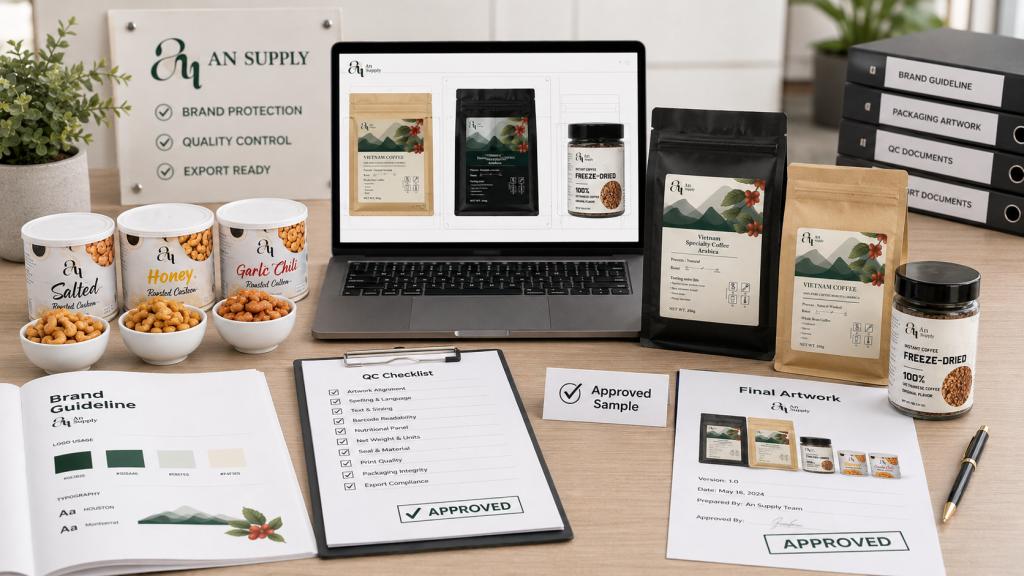
This guide explains how buyers can protect brand identity when building international sourcing partnerships with a supplier like An Supply.
1) Brand Protection Starts Before Production
Contents
- 1) Brand Protection Starts Before Production
- Buyers should define:
- Buyer insight
- 2) Packaging and Label Files Need Control
- Buyers should control:
- 3) Product Specifications Protect the Brand Promise
- Specification files should include:
- Risk control matrix (what can go wrong → what buyers must control)
- 4) Use QC as Brand Protection
- Pre-loading QC should help confirm:
- 5) Why An Supply’s Service Mindset Matters
- 6) Brand Protection Checklist for the Next Order
- Extra buyer safeguards (operational, not legal-only)
- 7) What Buyers Should Document Internally
- 8) CTA
Many buyers think brand protection begins after the product is made. That is too late.
Brand protection should begin before sampling, artwork, or production.
Buyers should define:
- Who owns the brand assets
- Which packaging file is final
- Which product claims are approved
- Who can approve changes
- What sample is the reference sample
- What QC criteria must be checked before loading
Buyer insight
Most brand problems are not dramatic. They often come from unclear approvals, old artwork, wrong label language, or a factory change that was not documented.
Transition: Once ownership is clear, the next priority is controlling packaging and label execution.
2) Packaging and Label Files Need Control
Packaging is the first thing your customer sees. For export markets, it is also a compliance and trust tool.
Buyers should control:
- Logo version
- Ingredient statement
- Nutrition panel
- Allergen information
- Country-of-origin language
- Certification claims
- Barcode and SKU codes
- Carton marks
If the product enters the US, EU, Middle East, Singapore, Japan, or Korea, label expectations may differ. That means packaging review should happen early—not after printing.
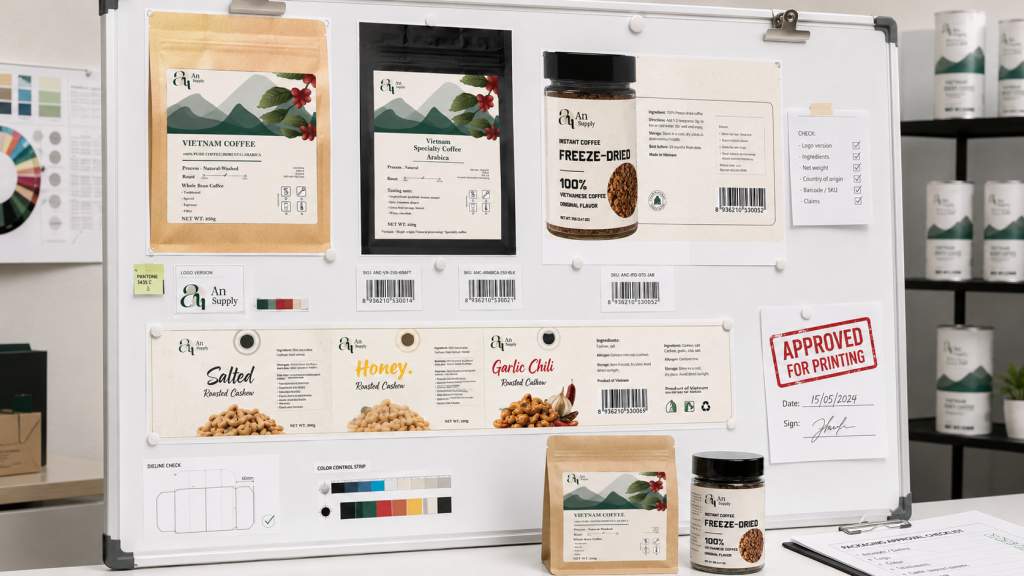
To strengthen your file governance and brand asset protection practices, buyers can reference practical intellectual property guidance from WIPO (SME resources).
3) Product Specifications Protect the Brand Promise
Your brand identity is not only visual. It is also the product experience.
If your cashew, coffee, spice, tea, dried fruit, or processed food changes from one shipment to the next, the brand loses trust.
Specification files should include:
- Product grade
- Size or cut
- Flavor profile
- Moisture target
- Packaging material
- Net weight
- Carton configuration
- Shelf-life expectation
- Inspection criteria
Risk control matrix (what can go wrong → what buyers must control)
| Risk area | What can go wrong | Buyer control point |
|---|---|---|
| Packaging | Old artwork or wrong claim is printed | Final artwork approval before printing |
| Product quality | Shipment differs from approved sample | Reference sample + QC checklist |
| Documentation | Export documents do not match product | Document review before shipment |
| Communication | Changes happen without buyer approval | Written change-control process |
Transition: After specifications are clear, QC becomes the practical tool that protects the buyer before shipment.
4) Use QC as Brand Protection
QC is not only about finding defects. It protects your brand promise before the product reaches the market.
Pre-loading QC should help confirm:
- Product appearance
- Packaging condition
- Label accuracy
- Carton quality
- Quantity readiness
- Shipment documentation
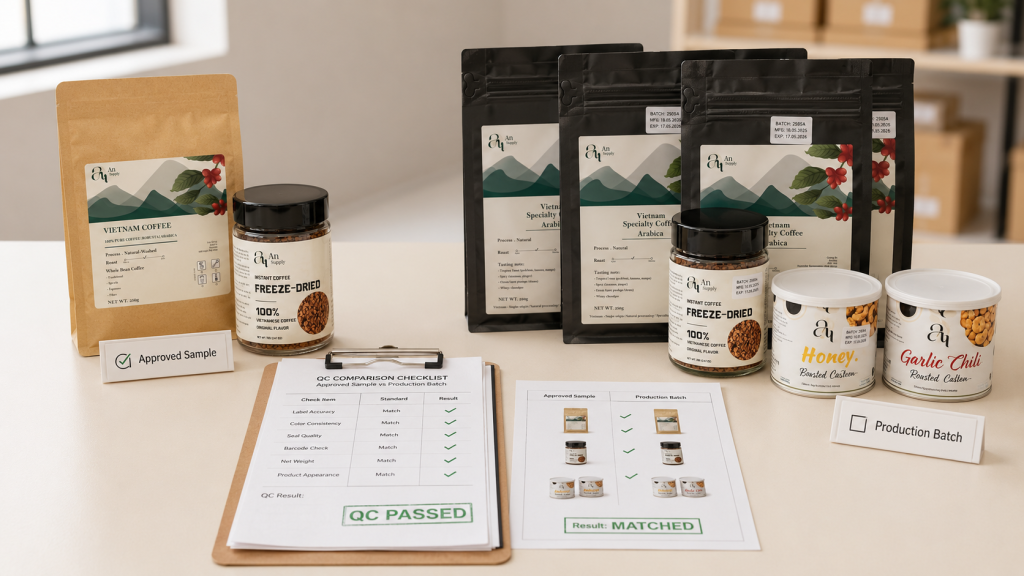
This is especially important for private label buyers because a shipment issue can affect retailer trust, customer reviews, and reorder planning.
If you want to understand how a supplier supports buyers beyond production—especially around communication, coordination, and responsibility—review An Supply’s service approach before you lock a long-term program.
5) Why An Supply’s Service Mindset Matters
Brand protection also depends on how the supplier behaves when things are not perfect.
In global trade, issues can happen:
- Packaging needs revision
- A document needs correction
- A sample requires adjustment
- A shipment timeline changes
- A buyer needs fast clarification
An Supply’s service value is accompaniment and responsibility. When a problem appears, the goal is not to leave the customer alone—the goal is to communicate clearly, coordinate the next step, and support resolution.
For buyers managing multi-category private label plans, it also helps to keep product scope aligned early with the right export-ready product categories.
6) Brand Protection Checklist for the Next Order
Before confirming the next order, buyers should check:
- Final artwork version
- Approved sample code or date
- Product specification sheet
- Packaging material and carton details
- Label claims and market language
- Inspection plan before loading
- Change approval process
This checklist keeps the supplier, buyer, and factory aligned. It also makes problem-solving faster if a detail needs correction.
Extra buyer safeguards (operational, not legal-only)
Brand protection export becomes stronger when buyers turn brand rules into daily operating checks.
Before confirming production, prepare:
- A final artwork folder
- An approved sample record
- A product specification sheet
- A packaging and carton checklist
- A label claim review
- A written change-approval process
This prevents brand protection export from becoming a “legal idea” only. It becomes a practical workflow that protects the buyer before printing, production, inspection, and shipment.
7) What Buyers Should Document Internally
Brand protection export also depends on the buyer’s own internal discipline.
Before sending files to a supplier, keep one approved folder for:
- Final logo files
- Final packaging artwork
- Approved claims
- Reference sample photos
- Label language
- QC criteria
This makes supplier communication faster and reduces the chance that an outdated file is used by mistake.
8) CTA
If you want a safer OEM/private label partnership that protects your brand identity from concept to shipment, contact An Supply through the Contact page to align brand assets, packaging controls, QC checkpoints, and change-approval rules from the start.