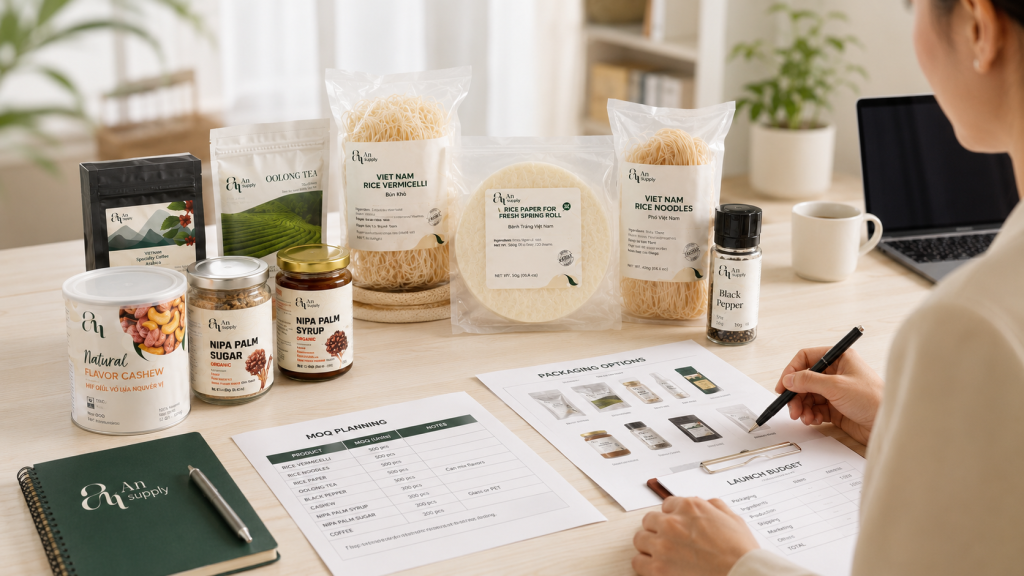
A flexible MOQ agricultural supplier can help a startup launch without taking unnecessary inventory risk.
For new brands, the first order is not only about buying goods. It is about testing:
- Product–market fit
- Packaging response
- Price acceptance
- Channel performance
- Customer feedback
- Reorder potential
If the MOQ is too high, the buyer may lock too much cash into unproven inventory. If the MOQ is too low, packaging and production may become unrealistic.
This guide explains how startups can use MOQ planning more intelligently—especially when working with an export partner like An Supply.Table of Contents
1) Flexible MOQ Does Not Mean Random Production
Contents
- 1) Flexible MOQ Does Not Mean Random Production
- Real MOQ flexibility means discussing:
- Buyer insight
- 2) MOQ Planning for the First 90 Days
- A practical launch plan
- 3) What Startups Should Prepare Before Asking for MOQ
- The brief should include:
- 4) How An Supply Supports Startup Buyers
- An Supply can support:
- 5) When to Scale Beyond the First Order
- Scale when you have evidence:
- 6) What Flexible MOQ Should Help You Learn
- What the first order should prove (non-negotiables)
- 7) How to Discuss MOQ Without Losing Leverage
- Useful questions include:
Some buyers hear “flexible MOQ” and expect unlimited customization at any quantity. That is not how serious export supply works.
Real MOQ flexibility means discussing:
- Available product formats
- Practical pack sizes
- Shared packaging options
- Sample approval process
- First-order volume
- Scale-up timeline
- Production feasibility
Buyer insight
A professional supplier should be honest about limits. If a supplier says yes to every request at any quantity, the buyer should check whether production, packaging, and QC can actually be controlled.
Transition: Once flexibility is understood correctly, the buyer can plan the first launch more safely.
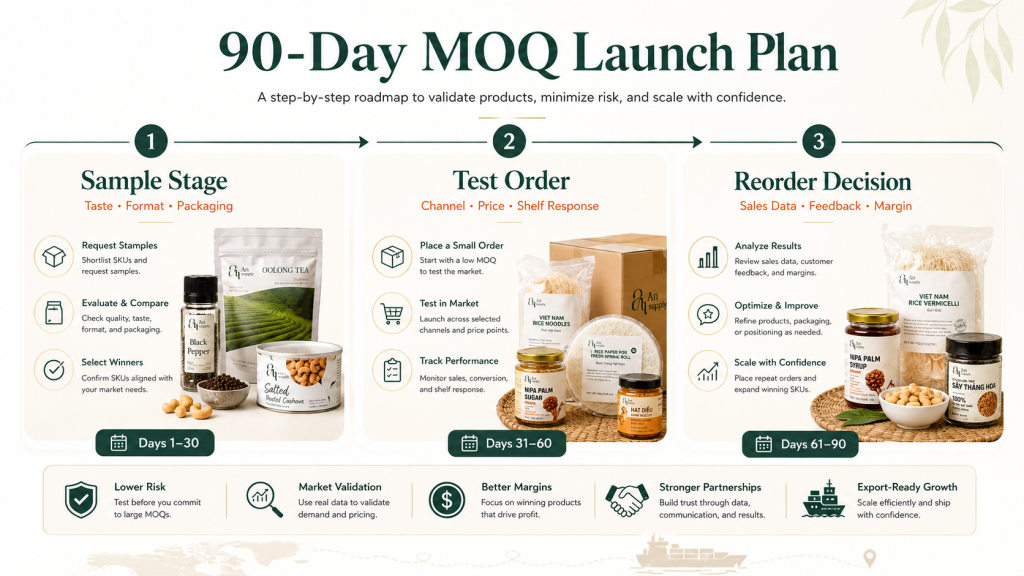
2) MOQ Planning for the First 90 Days
A startup should not treat the first order like a full-scale expansion. The first 90 days should be used to learn.
A practical launch plan
| Stage | Goal | Buyer focus |
|---|---|---|
| Sample stage | Validate product direction | Taste, format, packaging logic |
| Test order | Enter market carefully | Channel response, price, shelf behavior |
| Reorder decision | Scale or adjust | Sales data, customer feedback, margin |
This structure helps the buyer avoid emotional ordering. A product may look good in a sample room, but the market must prove that it can sell.
3) What Startups Should Prepare Before Asking for MOQ
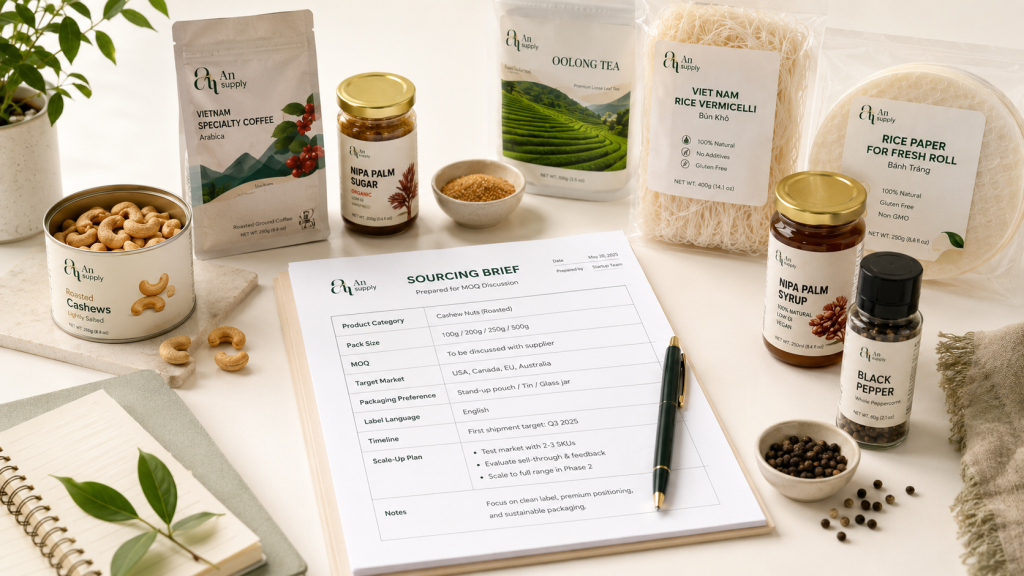
Before asking “What is your MOQ?”, startups should prepare a short brief.
The brief should include:
- Target market
- Product category
- Pack size
- Estimated first order
- Expected retail or wholesale price
- Packaging preference
- Label language
- Timeline
- Future scale-up plan
This helps the supplier give a useful answer. Without this information, MOQ discussion becomes too abstract.
4) How An Supply Supports Startup Buyers
An Supply supports agricultural and processed food buyers through a network of farms and large-scale factory partners. For startups, this can reduce confusion during the early stage—especially when you review the supplier’s operating approach on the About An Supply page before locking your first test order.
An Supply can support:
- Product option review
- OEM/private label discussion
- Sample development
- Packaging consultation
- QC planning
- Export documents
- Shipment coordination
To shortlist the right items for a startup-friendly test launch, it helps to start from the supplier’s product range and categories rather than trying to customize everything from day one.
For startups learning export fundamentals, trade planning resources from the International Trade Centre can also help set realistic expectations for documentation, lead times, and market entry.
Transition: MOQ is only useful if it leads to repeatable growth.
5) When to Scale Beyond the First Order
Flexible MOQ is a starting point. It should not become a permanent ceiling.
Scale when you have evidence:
- Repeat customers
- Stable channel feedback
- Acceptable margin
- Low complaint rate
- Packaging performance is proven
- Reorder timing is predictable
At that stage, larger orders may unlock better packaging, stronger pricing, and smoother production planning.
An Supply’s service mindset matters here: if the startup faces a problem, the goal is to support the buyer in finding a solution—not leaving the partner alone.
6) What Flexible MOQ Should Help You Learn
The first order should answer practical questions:
- Which SKU sells fastest?
- Which pack size feels right for the channel?
- Does the price leave enough margin?
- Does the packaging protect the product?
- Are customers asking for repeat purchase?
- Can the supplier repeat the same quality?
If the answer is positive, the buyer can scale with more confidence. If the answer is mixed, the buyer can adjust before committing to a larger container.
What the first order should prove (non-negotiables)
A flexible MOQ agricultural supplier should help the buyer learn before scaling. The first order should prove:
- Which SKU moves fastest
- Which pack size fits the channel
- Whether price leaves enough margin
- Whether packaging protects the product
- Whether customers understand the product quickly
- Whether the supplier can repeat the same quality
This is why flexible MOQ agricultural supplier support is valuable for startups: it reduces early risk while still preparing the brand for larger, more efficient orders later.
7) How to Discuss MOQ Without Losing Leverage
Startups should discuss MOQ as part of a growth plan, not as a one-line negotiation.
Useful questions include:
- What is realistic for a first test order?
- Which packaging options fit this volume?
- What changes when volume increases?
- Which costs are fixed and which costs improve later?
- How soon can repeat orders be planned?
If you want to discuss flexible MOQ options for your next agricultural, coffee, cashew, or processed food product, reach out through An Supply’s Contact page to map a realistic test order and a scale-up path.