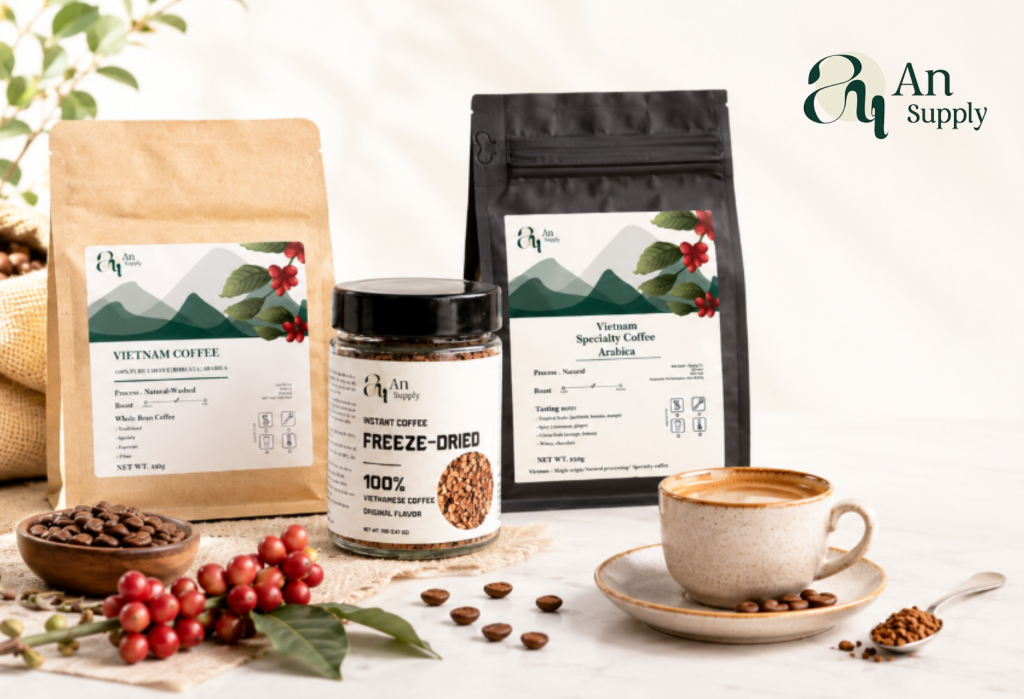
OEM coffee Vietnam is not just about finding a factory that can pack coffee under your label. For B2B buyers, it is about building a product system that can sell consistently, scale safely, and stay reliable across shipments. If you are launching a private label coffee line, the first question is not only: “Can you produce this?” The better question is: “Which model gives my brand the right level of control, support, and export reliability?” That is where OEM and ODM matter.
1) Start With the Brand Goal, Not the Production Term
Contents
- 1) Start With the Brand Goal, Not the Production Term
- 2) OEM vs ODM: What Buyers Should Understand
- What OEM means
- What ODM means
- OEM vs ODM comparison (buyer decision matrix)
- Buyer insight
- 3) Robusta vs Arabica: Practical Comparison for Coffee Buyers
- 4) Buyer Insight: How to Avoid a Weak Coffee Brief
- Your brief should include:
- 5) QC, Packaging, and Consistency
- Key control points include:
- 6) Why Buyers Choose An Supply
- 7) Final Recommendation
- How can I protect consistency across shipments?
- Simple decision rule (for most buyers)
- 8) Final Thought
Many buyers start by asking: “Do you provide OEM or ODM?” That question is useful, but it comes too early.
A better first question is: What should your coffee brand be known for?
Different brand goals create different development paths:
- Strong espresso with high crema
- Smooth daily coffee for retail shelves
- Premium aroma-led Arabica profile
- Robusta-forward blend for milk-based drinks
- Instant coffee or soluble-friendly direction
- Gift pack for specialty or seasonal sales
When the brand goal is clear, OEM coffee Vietnam becomes easier to manage because the supplier can connect the goal with sourcing, production, packaging, QC, and export execution—especially when you work with a partner like An Supply who understands end-to-end export execution.
Transition: Once the brand goal is clear, the next step is choosing the right production model.
2) OEM vs ODM: What Buyers Should Understand
What OEM means
OEM means the buyer already has a clear product direction. You may know the target market, blend style, packaging format, label direction, carton requirement, and shipment plan.
What ODM means
ODM means the buyer still needs product development input. The supplier helps shape the product concept, sample direction, packaging structure, and practical production route.
OEM vs ODM comparison (buyer decision matrix)
| Criteria | OEM Model | ODM Model |
|---|---|---|
| Buyer role | Provides clear product requirements | Provides market idea or business goal |
| Supplier role | Executes approved specifications | Helps develop product direction |
| Best for | Established private label programs | New product launches or early concepts |
| Main benefit | More brand control | Faster product development support |
| Main risk | Weak brief causes execution mistakes | Unclear ownership of final concept |
| An Supply support | Sourcing, QC, packaging, export execution | Requirement analysis, R&D direction, samples, factory matching |
Buyer insight
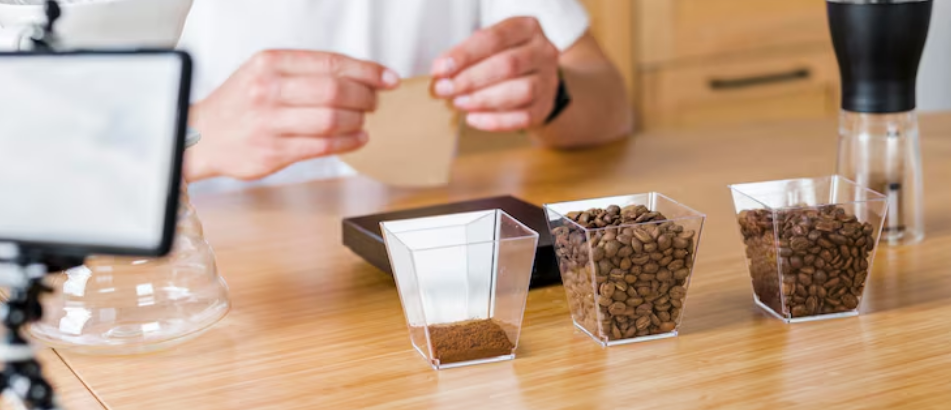
Choose OEM if your team can already describe the product clearly. Choose ODM if your team still needs help turning market demand into a product that can be sampled, packed, and shipped.
Transition: For coffee buyers, this decision often becomes more practical when comparing Robusta and Arabica.
3) Robusta vs Arabica: Practical Comparison for Coffee Buyers
Many buyers ask whether they should use Robusta, Arabica, or a blend. The answer depends on the product’s selling role. Let’s strip away the clichés and look at buyer outcomes.
| Factor | Robusta often brings | Arabica often brings |
|---|---|---|
| Cup profile | Strong body, bold intensity, deeper bitterness | More aroma complexity, brighter acidity, cleaner finish |
| Espresso performance | Higher crema potential | More fragrance and flavor complexity |
| Cost structure | Often more cost-efficient | Often supports premium positioning |
| Best use case | Milk-based drinks, instant coffee, strong daily coffee | Premium retail, specialty-style branding, aroma-led products |
| Buyer risk | Can taste harsh if poorly processed or roasted | Can become costly or inconsistent if sourcing is weak |
The best OEM coffee Vietnam projects do not choose Robusta or Arabica because of a trend. They choose based on:
- Customer drinking habit
- Sales channel
- Price positioning
- Roast direction
- Packaging and shelf-life plan
- Ability to repeat the same cup in future shipments
4) Buyer Insight: How to Avoid a Weak Coffee Brief
A weak brief usually creates weak execution. Before asking for a quotation, prepare a simple coffee brief.
Your brief should include:
- Target country or region
- Retail, foodservice, or private label channel
- Preferred coffee format
- Robusta, Arabica, or blend direction
- Target taste profile
- Pack size
- Packaging material
- Expected order volume
- Shelf-life requirement
- QC expectation before loading
If you cannot answer these points yet, ODM-style support may help. If you can answer them clearly, OEM coffee Vietnam execution may be the better path—especially when you align early with a partner’s About / capability overview to understand how they coordinate sourcing, packaging, QC, and export documentation.
5) QC, Packaging, and Consistency
A sample can impress your team once. A scalable coffee product must satisfy customers again and again.
Private label buyers lose money when:
- The second shipment tastes different from the first
- Crema drops after scale-up
- Packaging does not protect aroma
- Label details need correction after printing
- QC standards are unclear before loading
That is why OEM coffee Vietnam projects should include quality and packaging control from the beginning.
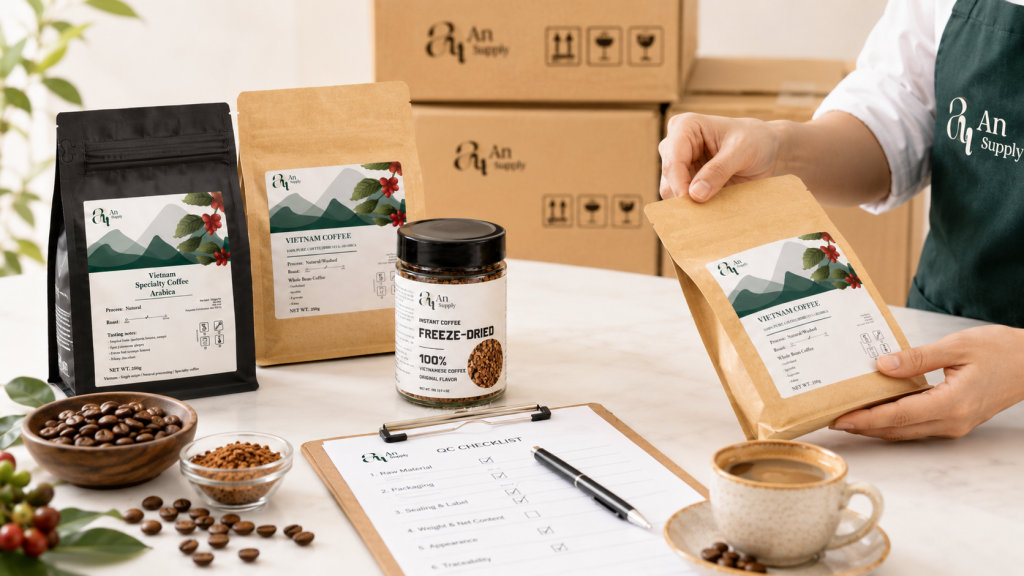
Key control points include:
- Approved reference sample
- Clear flavor and performance specs
- Packaging barrier review
- Label and carton confirmation
- Pre-shipment inspection
- Export document alignment
To support export readiness planning, buyers can reference practical guidance and market tools from the International Trade Centre, and align quality expectations with internationally recognized ISO standards where relevant.
6) Why Buyers Choose An Supply
An Supply supports B2B buyers who need more than a one-time sample. The company supports agricultural products, coffee, cashews, and processed foods through a network of farms and large-scale factory partners.
For OEM and ODM projects, An Supply can help with:
- Requirement analysis
- Product sample development
- Farm and factory partner coordination
- OEM/private label discussion
- Packaging and label support
- Strict QC before loading
- Export, customs, and shipment coordination
Most importantly, An Supply’s service mindset is based on accompaniment and responsibility. If a problem appears during sampling, packaging, QC, documentation, or shipment, the goal is not to leave the buyer alone. The goal is to communicate clearly and support the next solution—while keeping your product scope aligned with the right product categories from the start.
7) Final Recommendation
How can I protect consistency across shipments?
Use an approved sample, clear specs, packaging checks, and QC before loading. Consistency is what protects repeat orders.
Simple decision rule (for most buyers)
- If your spec is clear → choose OEM for control and stable execution
- If your spec is still forming → choose ODM for development support and speed
- If you’re launching new markets/products → consider ODM first, then OEM after the winning product is approved
8) Final Thought
OEM coffee Vietnam is strongest when it combines brand control with export discipline. The right partner should help you turn a coffee idea into a product your customers can trust—shipment after shipment.
If you’re ready to discuss your OEM or ODM coffee project, reach out via the Contact page to build an export-ready private label product with practical support from concept to container.