Sustainable cashew sourcing is no longer just a brand story. For B2B buyers, it is a risk-control system.
A buyer needs to know:
- Where the product comes from
- How quality is controlled
- Whether the supply can be repeated
- What documents can support the shipment
- How the supplier responds when problems appear
Without traceability, the buyer is relying too much on trust and too little on evidence.
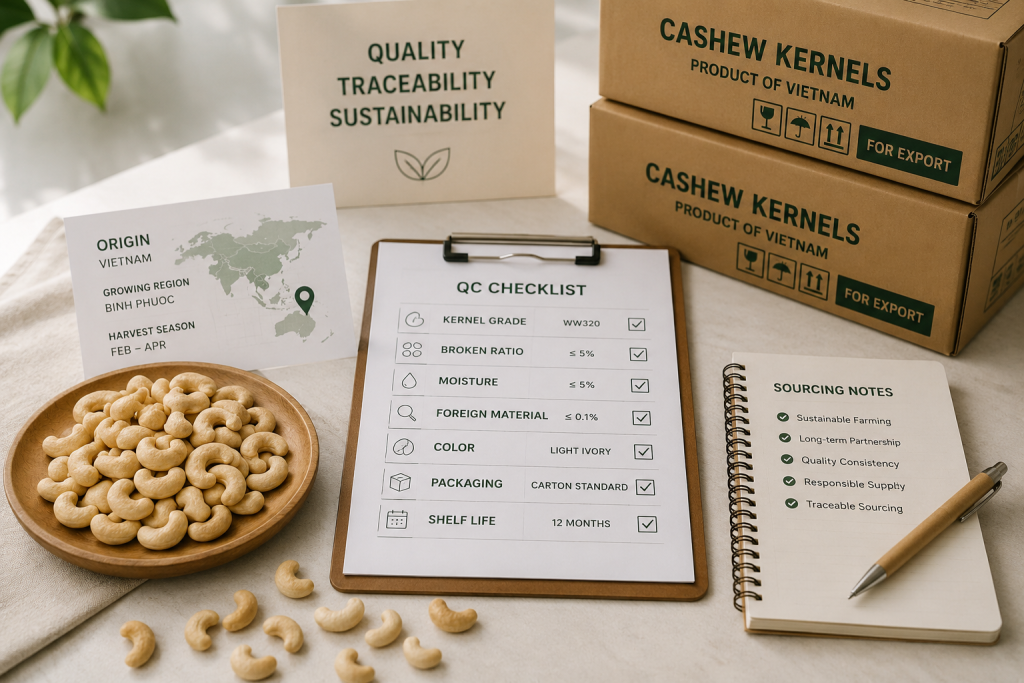
This guide explains what sustainable and traceable sourcing should mean in practice—especially for buyers building long-term import programs with a supplier like An Supply.
1) What Sustainable Cashew Sourcing Really Means
Contents
- 1) What Sustainable Cashew Sourcing Really Means
- A serious sourcing process should consider:
- Buyer insight
- 2) Traceability: What Buyers Should Ask
- Core traceability questions (and why they matter)
- 3) Quality Still Comes First
- Buyers should check:
- 4) Build a Traceability Brief Before Asking for Price
- Include:
- 5) How An Supply Supports Sustainable Cashew Buyers
- 6) Red Flags Buyers Should Watch For
- Be careful when a supplier:
- Buyer red flags (quick scan)
- 7) How Buyers Can Use Traceability in Sales
Sustainable cashew sourcing is not just adding “responsible” to a product description. It should connect sourcing, quality, documentation, and long-term supply.
A serious sourcing process should consider:
- Raw material origin
- Farm and processor relationships
- Kernel grade and quality
- Handling and storage
- Packaging protection
- Export documentation
- Pre-shipment inspection
- Issue-resolution responsibility
Buyer insight
If sustainability cannot be checked, it becomes marketing language. Buyers should ask for practical visibility, not vague promises.
Transition: Once sustainability is defined practically, traceability becomes the next question.
2) Traceability: What Buyers Should Ask
Traceability helps buyers follow the product through the supply chain. It does not remove every risk, but it gives the buyer better control.
Core traceability questions (and why they matter)
| Traceability question | Why it matters to buyers |
|---|---|
| What product grade is being supplied? | Prevents mismatch between price and quality |
| What processing or packing step is involved? | Helps evaluate hygiene and consistency |
| What documents can be prepared? | Supports import, retail, and claim review |
| What QC happens before loading? | Reduces shipment disputes |
| How are issues handled? | Shows supplier responsibility |
For cashews, traceability should support both quality and credibility.
3) Quality Still Comes First
A responsible sourcing story is not enough if the product arrives with quality problems.
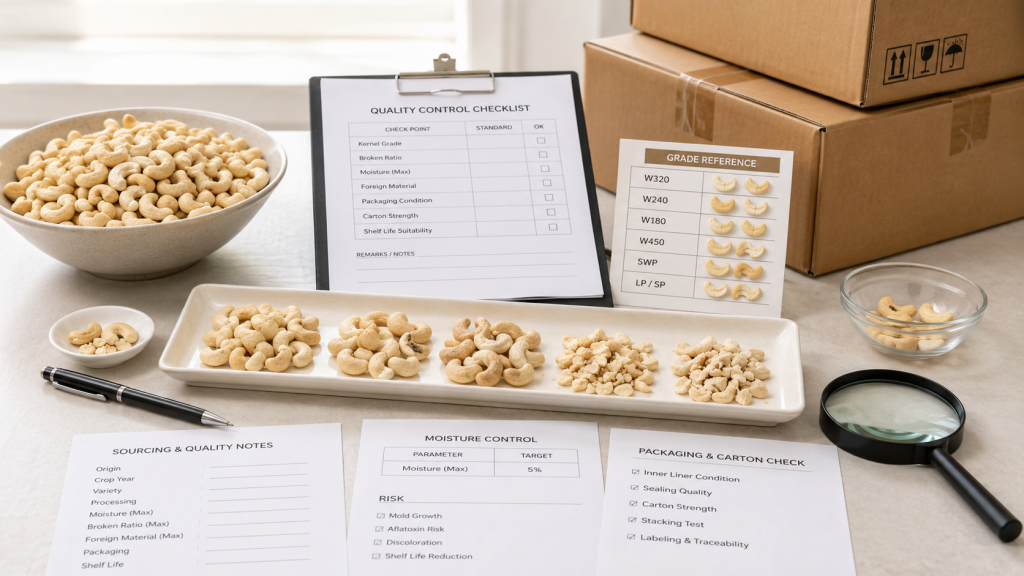
Buyers should check:
- Kernel grade
- Broken ratio
- Moisture risk
- Foreign material control
- Packaging condition
- Carton strength
- Shelf-life suitability
To align on global trade expectations for cashew kernels, it’s useful to review a reference framework like AFI standards—then go one step further with practical QC controls and repeatability checks. For deeper context, buyers can read An Supply’s AFI Standards article.
Transition: Quality and traceability become stronger when the buyer prepares a clear sourcing brief.
4) Build a Traceability Brief Before Asking for Price
Before requesting a quote, buyers should prepare a traceability brief.
Include:
- Target market
- Cashew grade
- Processing format
- Packaging type
- Expected claim
- Documentation needs
- Inspection requirements
- Reorder expectation

This helps the supplier respond with relevant information. It also helps the buyer compare suppliers more fairly. A low price without traceability, QC clarity, or packaging protection may not be the best commercial choice.
For broader agriculture and food-system context (especially when buyers need to align internal ESG and sourcing narratives with reality), buyers can reference resources from the FAO.
5) How An Supply Supports Sustainable Cashew Buyers
An Supply works with farm and factory partners that support export-oriented agricultural supply.
For cashew buyers, An Supply can support:
- Product option review
- Sourcing discussion
- Packaging planning
- QC coordination before loading
- Export document preparation
- Shipment communication
The company’s value is not only in finding supply. It is in coordinating responsibly and staying with the buyer when questions or issues appear—supported by a service approach explained in About An Supply and grounded in practical export execution.
6) Red Flags Buyers Should Watch For
Not every sustainability claim is useful.
Be careful when a supplier:
- Uses broad claims without documents
- Cannot explain grade differences
- Avoids discussing QC before loading
- Treats packaging as an afterthought
- Cannot describe how issues are handled
- Gives only price without sourcing context
These are not automatic deal-breakers, but they require deeper questions. A serious sourcing partner should be willing to explain what can be verified and what still needs checking.
Buyer red flags (quick scan)
Sustainable cashew sourcing should be supported by practical evidence. Be careful when a supplier:
- Uses broad claims without documents
- Cannot explain grade differences
- Avoids discussing QC before loading
- Treats packaging as an afterthought
- Gives only price without sourcing context
- Cannot describe how issues are handled
These signs do not always mean the supplier is wrong. But they do mean the buyer should ask deeper questions before confirming sustainable cashew sourcing for a private label or import program.
7) How Buyers Can Use Traceability in Sales
Traceability is not only useful for procurement. It can also support the buyer’s sales team.
When the sourcing story is clear, sales teams can explain:
- Why the product is reliable
- How quality is checked
- What packaging protects the cashews
- Which documents support the shipment
- Why the supplier relationship is repeatable
This helps sustainable cashew sourcing become a commercial advantage, not only an internal sourcing requirement. For importers, this also supports internal reporting: procurement, quality, sales, and logistics teams can use the same traceability brief to understand what has been promised and what still needs verification.
To align sustainable cashew sourcing expectations with real export execution, contact An Supply via the Contact page to discuss traceability requirements, QC checkpoints, packaging protection, and documentation planning for your target market.